I killed my Monday morning reporting.
Before: every Monday, 8 hours exporting CSVs, cross-referencing numbers, and writing briefs nobody reads. Today: 20 minutes. Here's what actually changed.
By Thibault
8 hours a week, evaporating into CSVs
Every Monday morning, same drill. Export the week’s performance, cross-reference flows and campaigns in a spreadsheet, spot what moved, then write the briefs for the next campaigns. Eight hours. Every single week.
The worst part? Those eight hours generated zero revenue. It was time spent on observation, not decisions. And half the reports went unread.
Three steps brought that Monday down to 20 minutes.
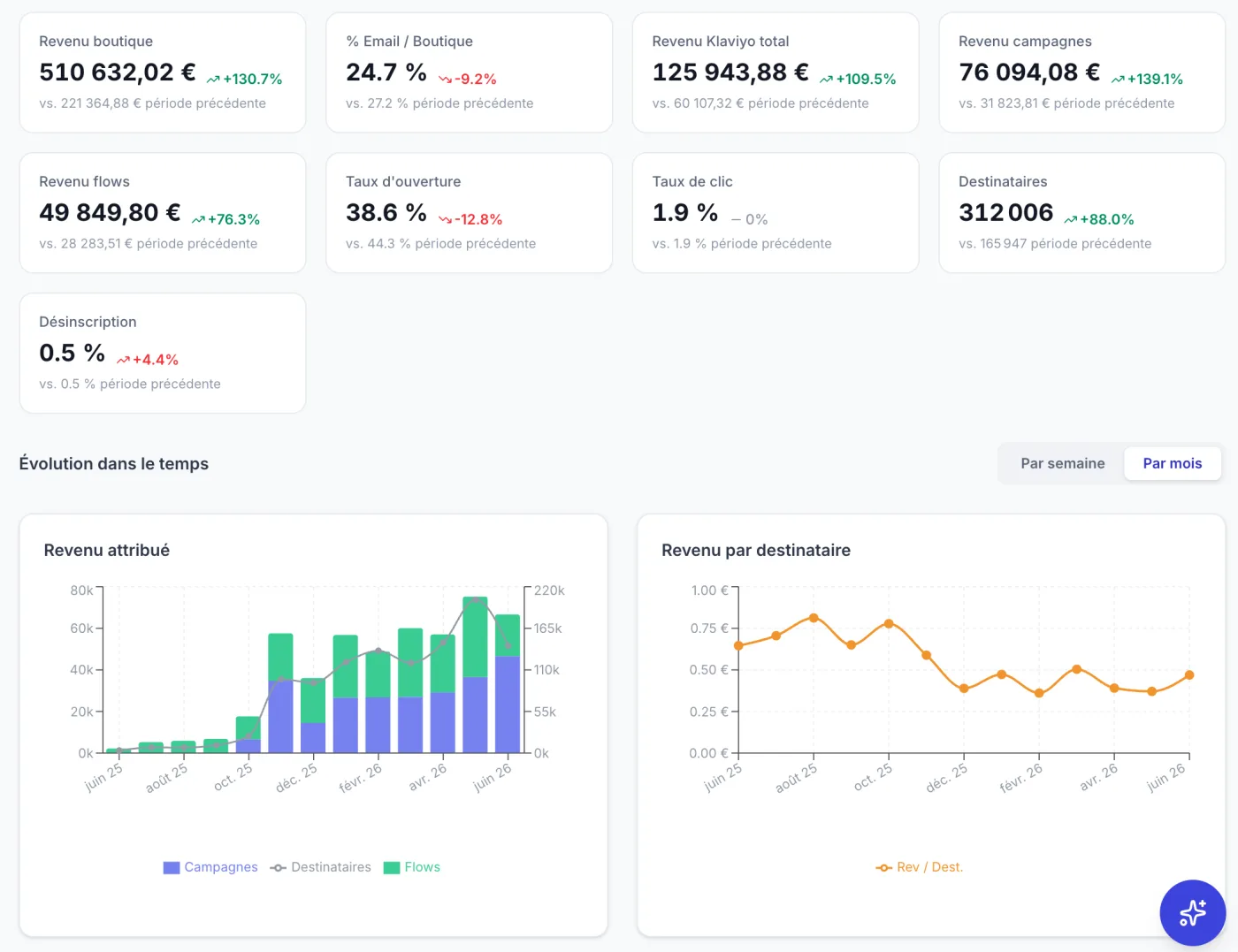
Step 1: a dashboard you can read in 30 seconds
Manual reporting started from the wrong premise: look at everything. In practice, 90% of the numbers don’t require any action in a given week.
The right reflex: only surface what changed, or what breaks a threshold. Not 40 metrics, just the 3 or 4 anomalies of the week. An RPR drop on a segment, a flow tanking, a deliverability signal. Ignore the rest.
Result: reading goes from 2 hours of spreadsheet work to a 30-second glance.
Step 2: campaign briefs in 30 seconds (vs 1 hour)
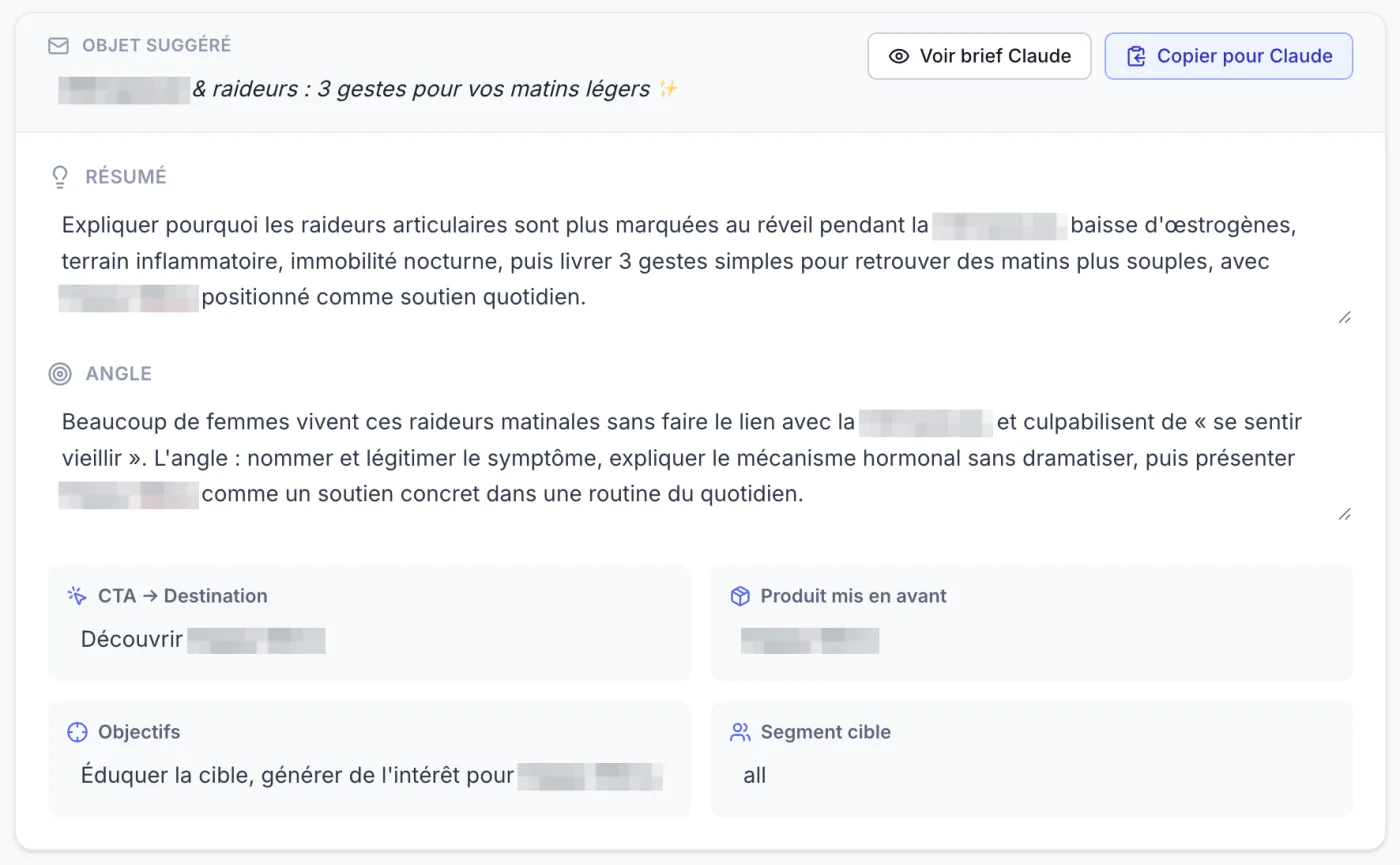
Writing a campaign brief by hand (angle, target segment, subject line, structure) used to take an hour per campaign. Multiply by 8 to 16 campaigns a month and do the math.
What changed everything: starting from a brand document (voice, offers, do’s and don’ts) and generating the brief from it, instead of starting from a blank page every time. The brief comes out in 30 seconds, already aligned with the brand, ready to go into production.
Step 3: alerts instead of surveillance
Manual surveillance is the illusion of control: you look at everything, all the time, so you see nothing in time. A VIP slipping away, deliverability drifting: that doesn’t show up in a weekly export.
The shift: stop watching, get alerted. A threshold gets crossed, an alert fires. The rest of the time, you don’t touch anything. It feels less “reassuring” than opening a spreadsheet every morning, but it’s what actually catches problems before they get expensive.
The result: from 8h to 20 minutes
- Dashboard reading: from 2h to 30 seconds
- Campaign briefs: from ~6h to a few minutes
- Surveillance: continuous, without thinking about it, via alerts
Monday morning is no longer a wall. And more importantly, the time saved doesn’t disappear: it goes back into what actually creates revenue, testing offers, taking care of VIP segments, building the missing flows.
Reporting should never be a job. It’s a byproduct. If you’re still spending your Mondays on it, connect your Klaviyo and see what a cockpit looks like when it reads, prioritizes, and writes for you.
Guides connexes
The 7 essential Klaviyo flows (and how much each should make)
Which flows to have, in what order, and how much each one generates.
The LabYour Klaviyo dashboard is lying to you
The 4 blind spots the native dashboard won't show you.
The Lab+38% Klaviyo revenue in 90 days
The 3 revenue levers, broken down one by one.