+38% Klaviyo revenue in 90 days: the 3 levers that actually move the needle
+38% isn't magic, and it isn't a growth hack. It's what happens when you stop chasing new customers and fix three leaks you already have. We take them in order of impact.
By Thibault
+38%, no bullshit
When you hear “+38% Klaviyo revenue in 90 days”, the first reaction is healthy: skepticism. So let me say upfront where the number comes from.
It doesn’t come from a clever subject line or a shiny new template. It comes from fixing three leaks that nearly every DTC account has in common. None of them require more traffic or more ad spend. Just recovering revenue that’s already within reach.
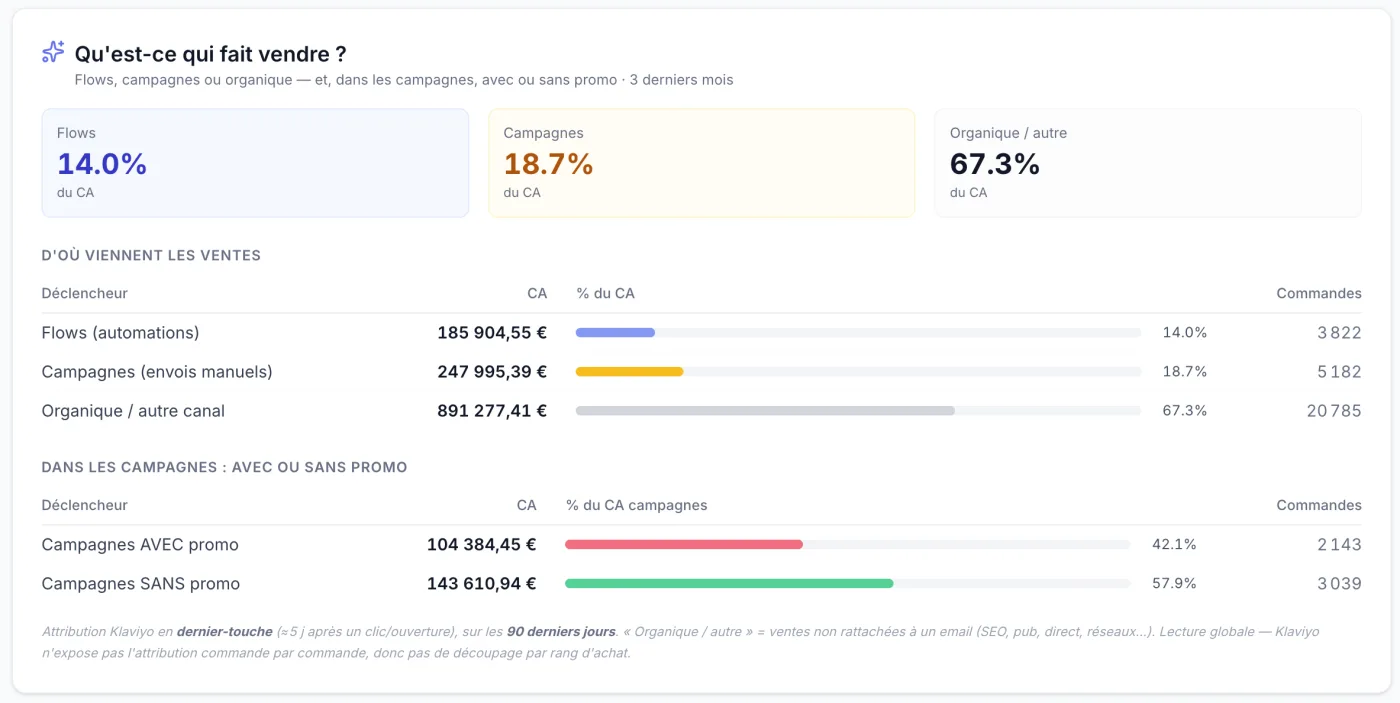
We take them in order of impact.
Lever 1: the second purchase (the biggest and the most ignored)
On a typical DTC brand, 60 to 75% of buyers never place a second order. Each one cost money to acquire, and all that investment evaporates after the first sale.
The culprit, almost every time: a post-purchase flow that’s too short (1 to 2 emails) with no cross-sell logic.
What works:
- Extend post-purchase to 5+ emails, over 30 days
- Split by product purchased (a relevant cross-sell, not a generic one)
- Build a “1 order, 15 to 30 days” segment and talk to them every week
The math: 500 unique buyers/month, a repurchase rate that goes from 20% to 28%, a $70 AOV, that’s 500 × 8% × $70 = $2,800/month in extra revenue. Every month, compounding.
Lever 2: the VIPs who leave in silence
Your VIPs drive 30 to 50% of your revenue with 5 to 10% of your buyers. The problem: no one watches the moment a VIP starts slipping. They go from active to dormant with no alert.
What works:
- A “VIP at risk” segment (e.g., VIP with no purchase in 60 days)
- A dedicated reactivation flow, with an exclusivity angle (not a mass promo)
- RPR measured per segment, so you actually know where the money is
Bringing back even a handful of VIPs a month is $1,000 to $4,000/month.
Lever 3: deliverability that quietly erodes
The sneakiest one. It degrades slowly, silently, and by the time you notice it in your numbers, the revenue hit is already there.
The two signals to watch:
- Unsub rate per campaign under 0.30%
- Spam rate under 0.01%
Past that, you’re sending too often, to the wrong segment, or both. And every email that lands in spam is flow revenue (cart, welcome) that never makes it to the inbox.
The full math
Put end to end, on a DTC account between $1M and $15M:
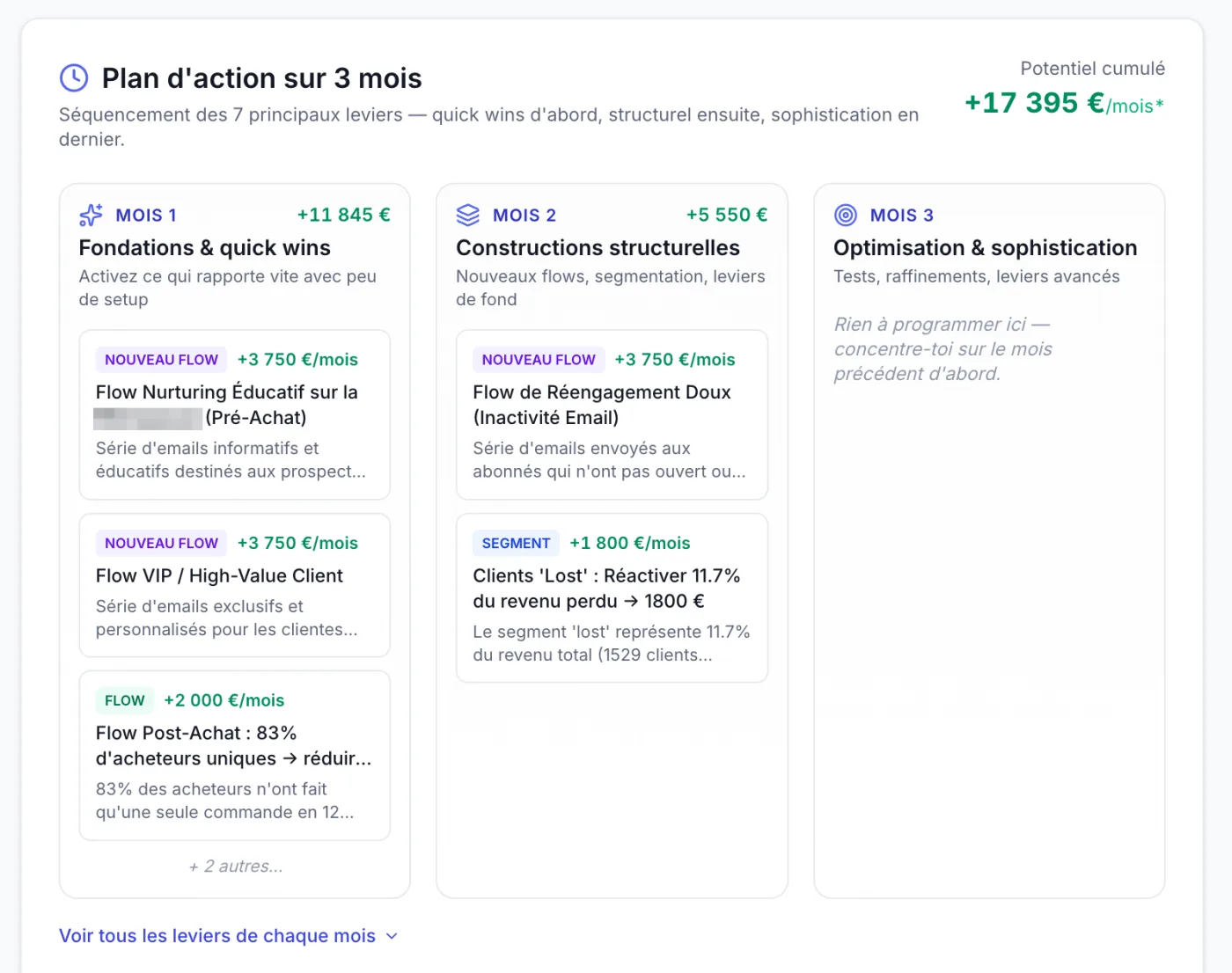
Recovery potential over 90 days
| Métrique | Votre valeur | Seuil | Statut |
|---|---|---|---|
| Lever 1: 2nd purchase (post-purchase) | +$1,500 to $5,000 | /month | ✓ |
| Lever 2: VIPs reactivated | +$1,000 to $4,000 | /month | ✓ |
| Lever 3: deliverability restored | +$1,000 to $4,000 | /month | ✓ |
On an email base that was already driving 25 to 40% of total revenue, this stack very often adds up to +30 to +40% of email revenue. Hence the +38%.
Where to start
Don’t go after all three at once. Identify your leak #1:
- Repurchase rate under 25%: start with lever 1
- No VIP-at-risk segment: lever 2
- Open rate sliding for 3 months: lever 3
If you don’t know which one is yours, that’s exactly what the free audit tells you in 5 minutes: your priority leak, sized in dollars, with the action to launch this week.
Guides connexes
5 revenue opportunities that 90% of DTC brands ignore
Each lever with its estimated impact in $ and the concrete actions.
RetentionRFM segmentation for ecommerce: a practical guide
The 8 RFM segments and their actions, segment by segment.
The LabYour Klaviyo dashboard is lying to you
The 4 blind spots the native dashboard never shows you.