You're flying blind on retention. Your data already shows where it's leaking.
A J+30 winback 'because that's what everyone does'. A 3-email welcome flow 'because that's the standard'. Except the right answer is in your data, not in a blog post.
By Thibault
Flying blind
Most DTC brands run their retention by copying others. A winback email at J+30 because a blog post said so. A 3-email welcome flow because “that’s the standard”. A reactivation campaign fired off on a hunch, whenever someone remembers.
The problem isn’t the actions themselves. It’s that they’re decided without ever looking at two numbers that actually matter:
- How many of your new subscribers actually buy, and how long does it take them?
- Among those who buy, how many buy again, and after how long?
Until you have those answers on your data, you’re optimizing blind.
Question 1: how many of your subscribers buy, and when?
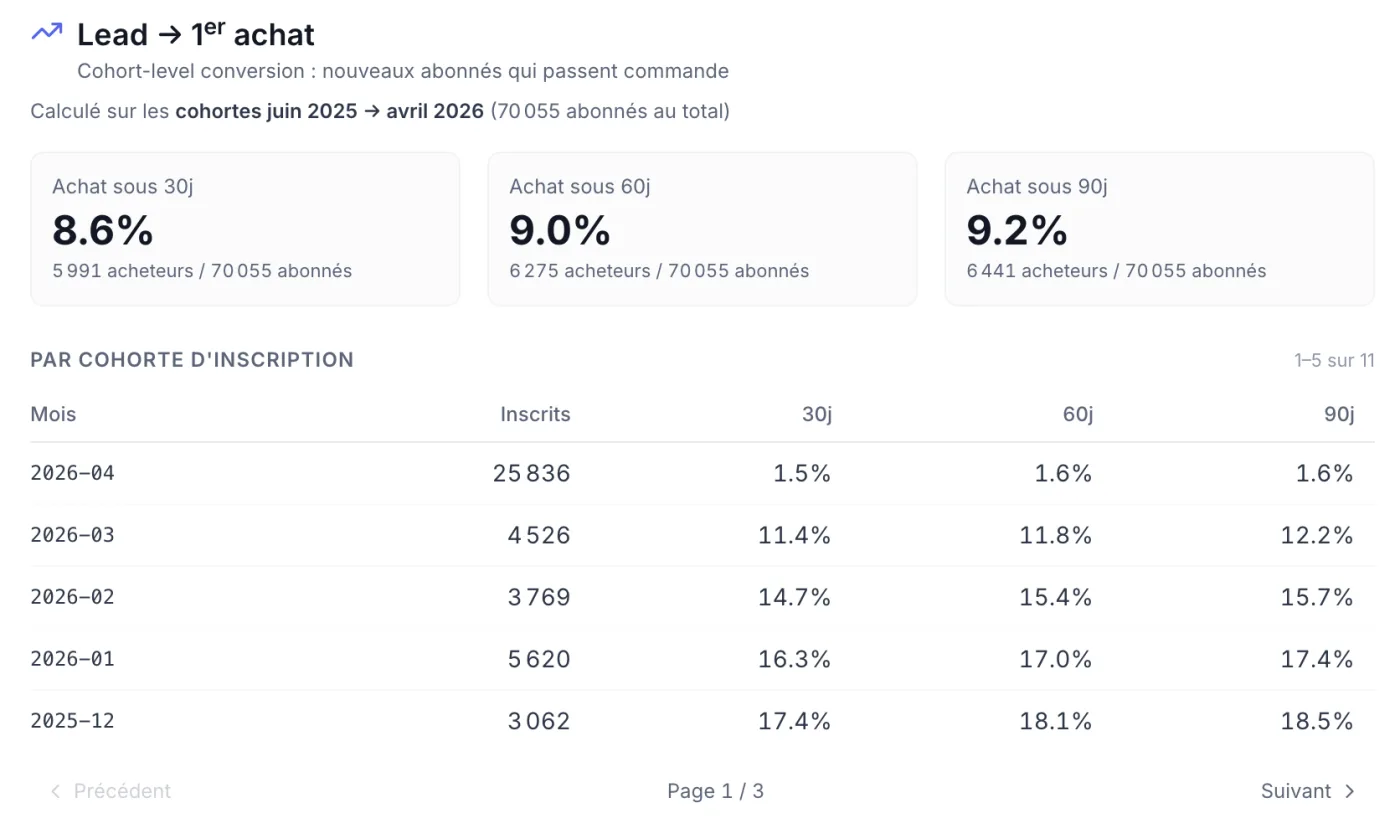
The first journey to measure is lead to first purchase. Not as a global number, but per signup cohort, at 30, 60 and 90 days.
Lead to first purchase conversion (5,547 subscribers)
| Métrique | Votre valeur | Seuil | Statut |
|---|---|---|---|
| Purchase within 30 days | 25.3% | of subscribers | ! |
| Purchase within 60 days | 26.1% | of subscribers | ! |
| Purchase within 90 days | 26.4% | of subscribers | ! |
Look closely: between day 30 and day 90, the number barely moves (25.3% to 26.4%). Almost all of the conversion happens in the first 30 days. Past that point, a subscriber who hasn’t bought almost never will.
The direct consequence: your welcome window is the whole game. If it’s weak, no late winback will save it. And when you look cohort by cohort, the gap speaks for itself (some months at 33%, others at 19%): that variation is a diagnosis in itself. What changed? The acquisition source, the welcome flow, the entry offer?
Question 2: do buyers buy again, and how fast?
The second journey is the repeat purchase. And that’s where most accounts bleed.
Repeat purchase journey (12,905 customers)
| Métrique | Votre valeur | Seuil | Statut |
|---|---|---|---|
| 2nd purchase | 20.7% | median delay 89 d | ! |
| 3rd purchase | 6.0% | median delay 74 d | ! |
| 4th purchase | 2.2% | median delay 62 d | ! |
| 5th purchase | 0.8% | median delay 56 d | ! |
Two takeaways.
First, the biggest leak is between the 1st and the 2nd purchase: only 20.7% of customers come back for another order. Nearly 80% never return. No other step in the journey loses that many people at once.
Second, the median delay shrinks at every step (89 d for the 2nd purchase, then 74, 62, 56…). The more loyal a customer, the faster they buy again. Your best customers have a rhythm, and that rhythm speeds up.
Why this changes everything for your winbacks
If your median delay before the 2nd purchase is 89 days, sending your “come back and see us” email at J+30 is too early: the customer wasn’t going to buy again yet anyway. Sending it at J+180 is too late: they’re already gone, or they bought somewhere else.
- Too early: you burn a touch for nothing.
- Too late: the window is already closed.
- Timed to your median delay: you land right when the urge to buy again kicks back in.
That’s the difference between “I send a winback at J+30 like everyone else” and “I send my winback around J+85, because that’s when my customers buy again”. The first is a guess. The second is driven by your data.
How Retain solves this in 1 click
Here’s what you see the moment you connect Retain. First, lead to first purchase conversion, cohort by cohort:
Then the full repeat purchase journey, with the median delay at each step:
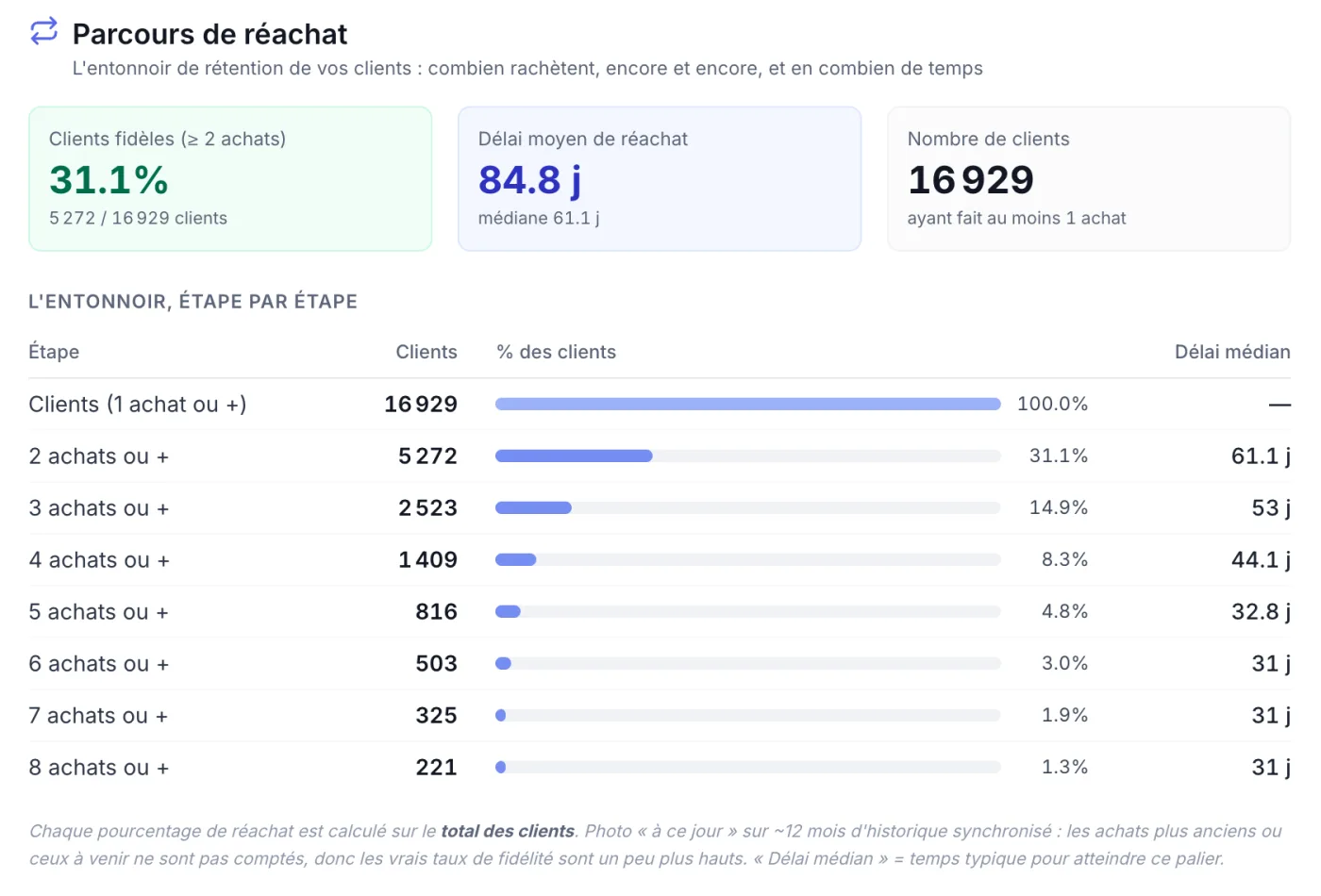
These two screens give you the two numbers your retention has been missing: when to follow up with a new subscriber (inside the first 30 days) and when to trigger your winback (around your median repeat delay, not at J+30 by default).
You can rebuild this by hand: export Shopify, cross-reference with Klaviyo signups, build the cohorts. Plan for several days of work, with a result that’s stale the next month.
Or you connect Retain. In a few minutes, you know where it’s leaking and when to time your flows.